Idea number one on our wall says the longest weather diary in history is sitting in un-OCR'd handwriting, kept by lighthouse keepers who wrote down the sky every few hours from the same rock for decades. So we took it off the wall. An AI read a keeper's log that no human had ever transcribed, and the temperatures it pulled off the page predate the official record for that town by a decade. Independent physics says it read right.
The one-paragraph version. On the coast of Oregon and the shore of Lake Michigan, lighthouse keepers logged the weather by hand for decades. Almost none of it has been read into a computer. We pointed an AI at the scans. On a book that did have a human transcription, it matched 14 days out of 14. Then we did the real thing: a book nobody had ever transcribed, where the only way to know if the machine read right is to ask the physics. It read right. Four AI readers took an entire 1884-85 logbook and recovered 122 days of daily temperature; against an independent reanalysis the reconstruction lands at r = 0.90, and r = 0.78 for the day-to-day weather with the seasons stripped out. And the record is new to the digitized climate archive: it beats the town's own official thermometer by about a decade.
The premise of idea number one is almost annoying in its simplicity. For a century and a half, keepers at fixed stations wrote the weather down, faithfully, every watch: the wind, the sea, the sky, and often a thermometer reading in the margin. It is arguably the most stable network of ocean-edge observers ever assembled. And it is nearly unusable, because it is handwriting, on paper, in archives, and reading a room full of cursive has always cost more human hours than anyone would spend.
That is exactly the kind of wall that just fell over. An AI can read the cursive now. The bottleneck was never the science. It was that nobody had read the paper.
A migration is a measurement. A keeper's diary is an instrument. Neither filed a report you could load.
We started where we could be graded. The Yaquina Head keeper logs (Newport, Oregon) have been partly transcribed by volunteers, so there is a human answer key. We handed the AI a page from January 1892 and asked it to read the wind and sea, cold.
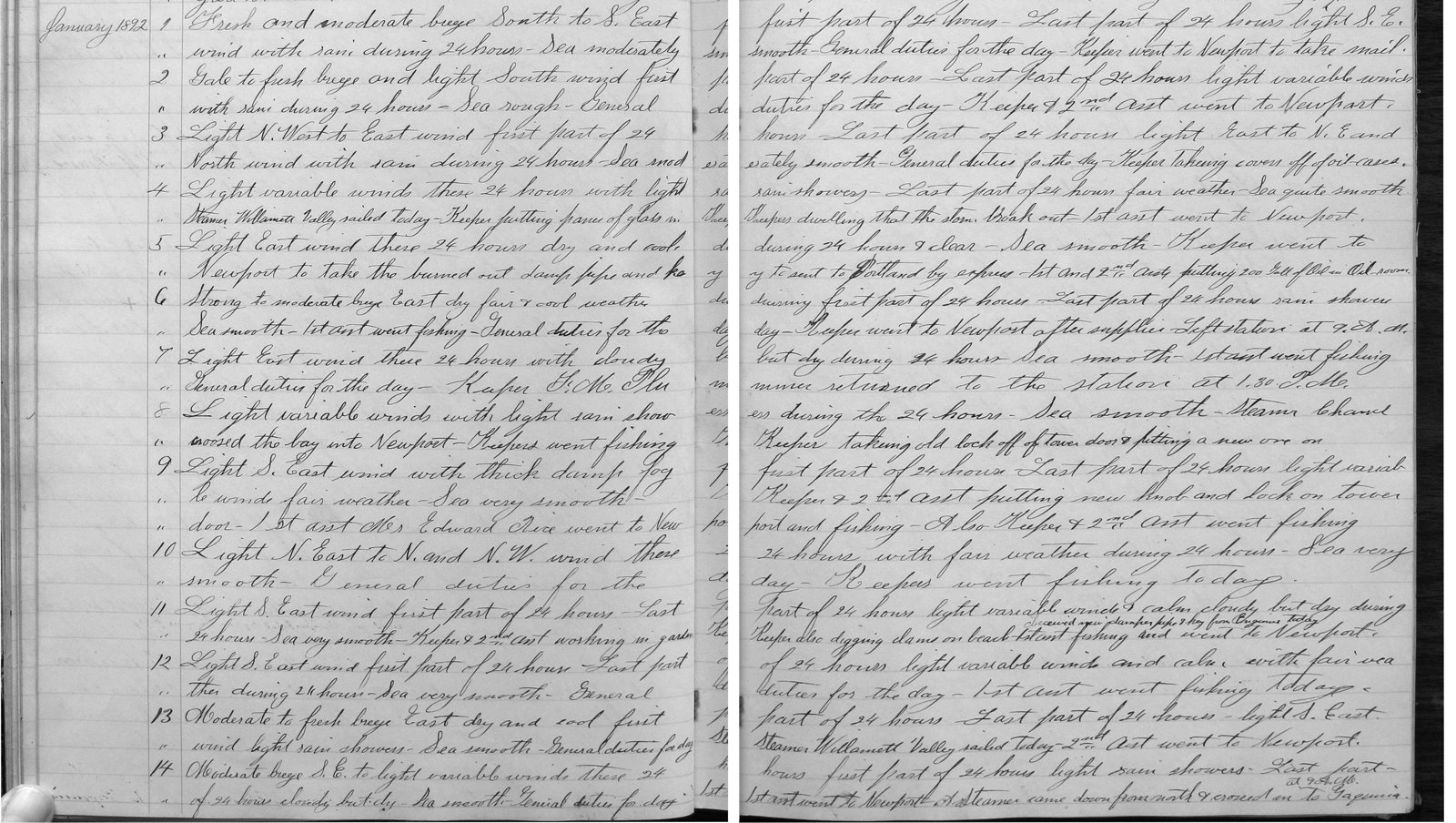
Good. The machine can read a keeper's hand. But matching a human transcription only proves it can do what a human already did. The interesting question is the paper nobody has touched.
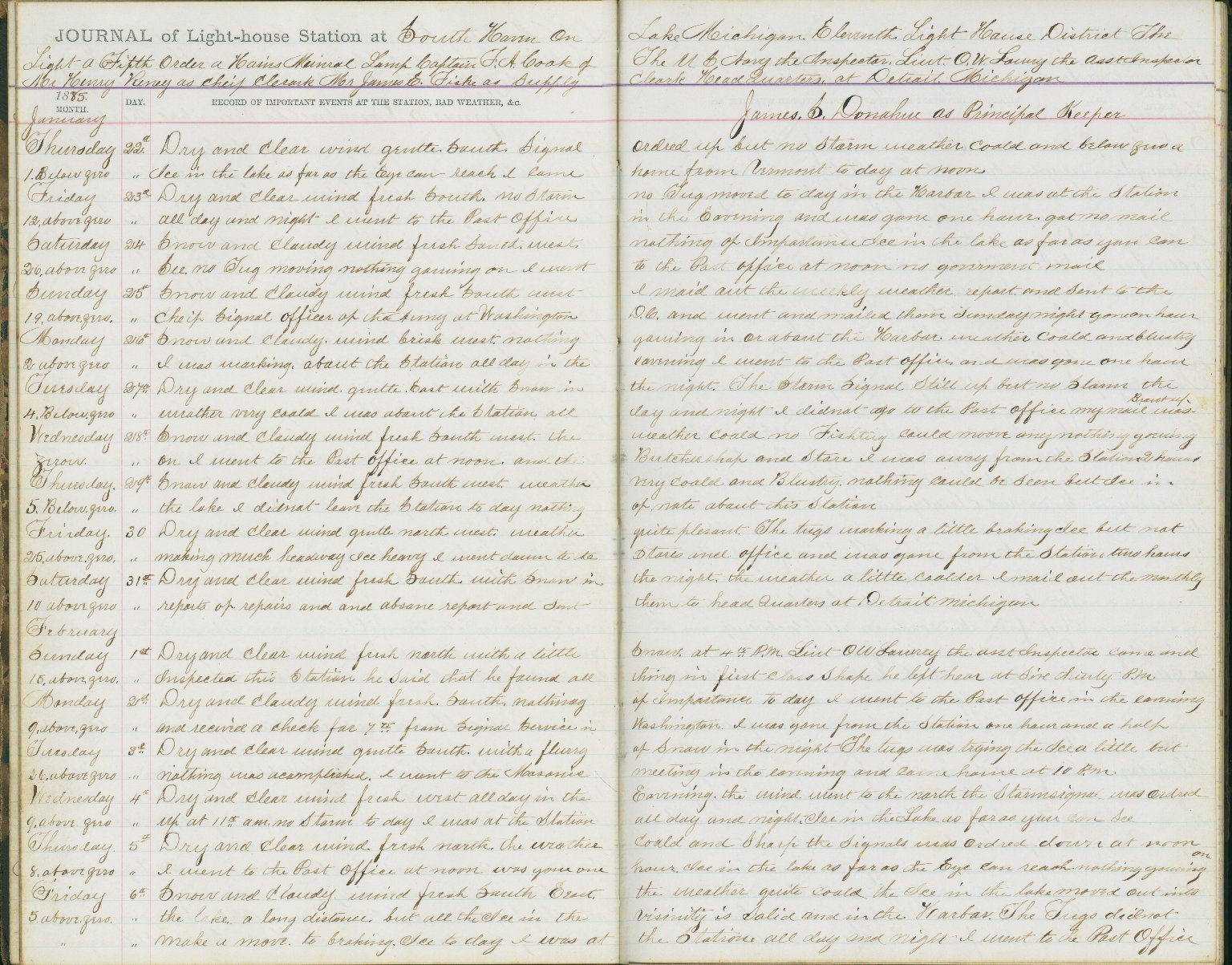
The South Haven journals, kept by keeper James Donahue on Lake Michigan in the 1880s, were digitized for preservation and then left alone. Page images, no transcription, no OCR, no dataset. Nobody had read them into anything. Which means there is no answer key at all - and that is precisely what makes them the right test. With no human transcript to lean on, the only thing that can tell you whether the machine read the handwriting correctly is whether the numbers it pulled off the page agree with independent physics.
The keeper wrote a thermometer reading in the left margin every day: "1 below zero," "26 above zero," "5 below zero." We read a stretch of them and checked against the 20th Century Reanalysis - a physical reconstruction of past weather that has never seen this book. The cold snaps and warm-ups lined up, day for day. So we did the whole book.
Four AI readers went through the ledger leaves in parallel, pulling each daily temperature into a structured record and flagging any digit they were unsure of. We stitched it into one continuous series and threw it at the reanalysis: December 1884 through the end of April 1885, deep winter to spring, from eighteen below to seventy above.
The mid-February plunge to eighteen below, the March swings, the surge into the seventies at the end of April: all of it, read off a keeper's hand, lands on the independent line. And a fact fell out of the reading itself - the keeper only wrote a daily temperature from December through April, then switched to narrative. You learn that by reading it, not by assuming it.
A hundred and twenty-two days of weather, written by a man in 1885, read by a machine in 2026, confirmed by the physics in between.
Honesty is the only currency the Guide respects, so we went looking for reasons this is less than it seems. Two questions: had anyone read this book before, and is our physics check actually independent?
One keeper, one winter, one lake town, is a small thing. But it is not the point. The point is that the whole chain ran end to end - find the scanned book, read the handwriting with a machine, reconstruct the record, confirm it against physics, check it against the archives for novelty - and it held. That chain is repeatable. The same rooms of unread paper that made idea number one sound quixotic are exactly the raw material this now turns into data.
Multiply one keeper by the thousands of digitized-but-unread station-years sitting in maritime museums and national archives, and the "longest weather diary in history" stops being a phrase on a wall and becomes a dataset. The instruments were always there. Someone just had to read the paper.
The dead kept better records than we gave them credit for. We finally learned to read their handwriting.
Don't panic. Bring a held-out set.